Democracy is Fragile: Handle with Care
Making the Presidency: John Adams

A Brief Book Review:
Making the Presidency by Lindsay M. Chervinsky
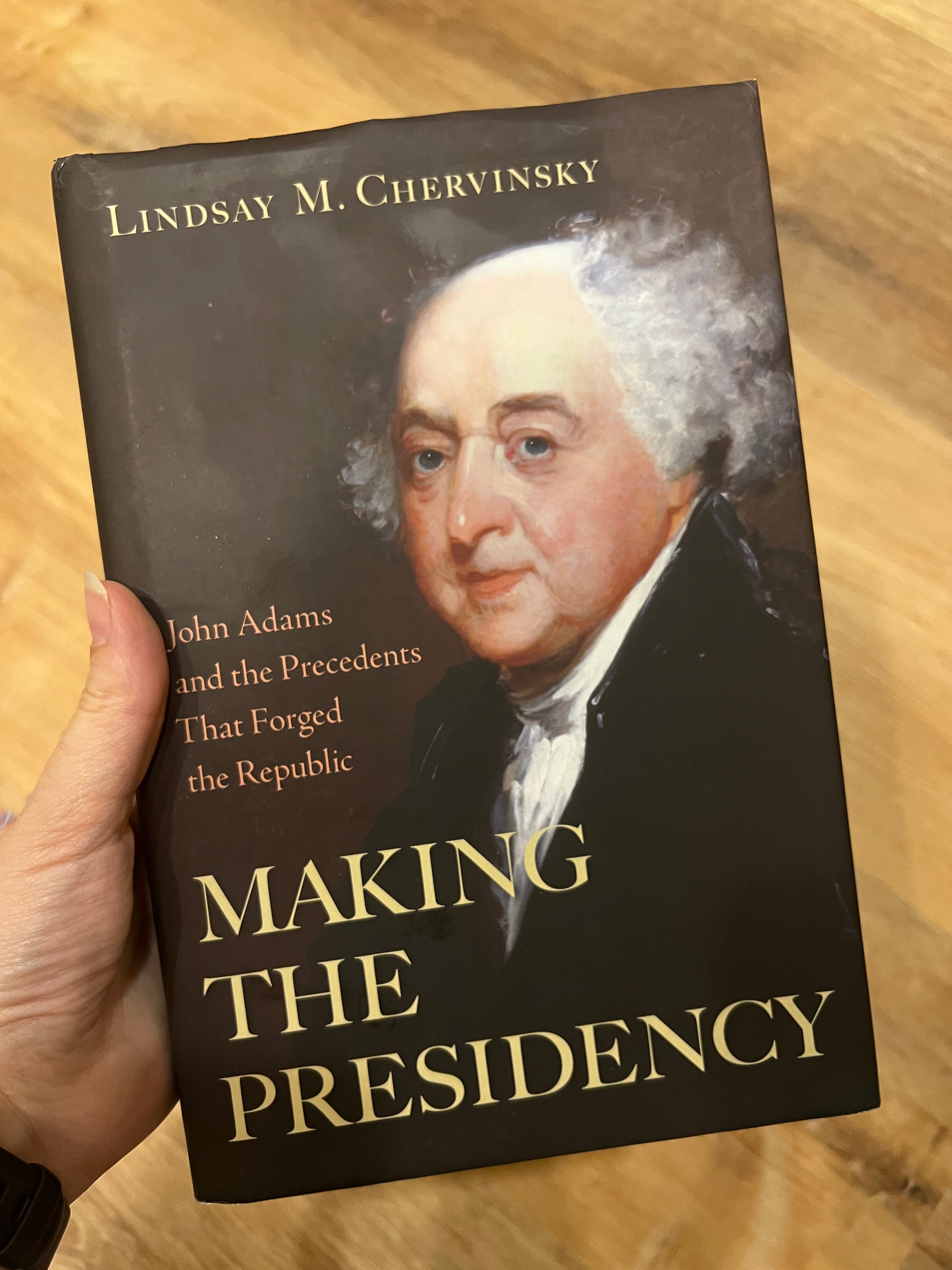
First of all, I loved this book. John Adams had a long and interesting life, and I think it takes a lot of courage as a writer tackling a fascinating subject to choose a narrow focus. As I said before, I found myself rooting for Adams. AND, I am just impressed because I was sitting on the edge of my seat, unable to put Making the Presidency down because I wanted to know if John Adams was going to win the election of 1800 (and I PROMISE I knew the answer)
History doesn’t repeat itself but it sometimes rhymes
Here is an incomplete list of ways John Adams’s Presidency made our current moment feel precedented:
John Adams, like President Joe Biden, was very interested and experienced in foreign policy and let other take the lead on domestic policy (and there were domestic protests that got out of control on his watch)
Of his two oldest sons, one was a model of upstanding behavior (and future President), the other struggled with addiction, abandoning his family and dying at the end of his Presidency (Abigail and John Adams had MANY children, so there were more)
His cabinet (and many politically engaged citizens) were frustrated because of all the time he spent at home in Quincy instead of in the Capitol doing the business of the country.
His party was embittered by internal disagreement between the moderate and extreme wings of the party, and they tried to replace him on the ticket just a few months before the election (led largely by Alexander Hamilton)
The election of 1800 was an Electoral College tie between Thomas Jefferson and Aaron Burr. It was our first Constitutional Crisis. Thomas Jefferson had (his friends) the Governor of Virginia (and future President James Madison) and the Governor of Pennsylvania ready to send their militias to attack the US Capitol if the (Federalist - minority party dominated) House of Representatives didn’t pick either Jefferson or Burr (the Democratic Republican winners of the Electoral College votes) for President.
Also, here is a delightful tidbit. John Adams presided over the building of the US Capitol. A House Representative from Pennsylvania described the new Capitol city this way:
“A few, indeed, drink, and some gamble, but the majority drink naught but politics, and by not mixing with men of different or moderate sentiments, they inflame one another.”
Some things never change, am I right?
Alexander Hamilton
I do think that this number from Hamilton (that was cut) about the Adams Presidency really sums up the relationship between General Hamilton and the President (I assure you, the animosity was mutual):
This book really leaves you with the sense that Alexander Hamilton was part American hero, and also (not unlike Elon Musk at the current moment) capable of a “demon mode” (think, The Reynolds Pamphlet - Hamilton also wrote a short booklet in the lead up to the 1800 election about how John Adams was unfit for the Presidency because he (Hamilton) could not manipulate and control him (Adams)). So, if you read Hamilton or have an affection for him from the musical, just know…you’re going to get a different side of him in this book (Also, perhaps this is unsurprising, the musical left out a lot. For example, I did not know that Alexander Hamilton was the General of the American Army. Now, part of the reason that’s not super important in US History is that the army was disbanded by John Adams because he avoided war with France through skilled diplomacy and patience, but that is not how it would have gone down if Hamilton had had his way). Also, by the end of Adams’s Presidency, he and Hamilton were not friends. Not even kind of.
A Few Thoughts
I don’t want to offer too many spoilers (you know, since John Adams hasn’t been President in 225 years). But, as Americans, we rightly revere the way George Washington willingly set aside power, both as General of the Continental Army and the first President of the United States. But John Adams, who was a man of many accomplishments (including negotiating the treaty to end the Revolutionary War , writing the Massachusetts Constitution and writing a handbook on how to write Constitutions that was a guide for the US Constitution) was the first US President to lose an election.
There was a lot of public concern during the Adams Presidency (largely fueled by propaganda, an overzealous Secretary of State, and Thomas Jefferson’s paranoia) that John Adams would try to hold power as a monarch. His party, the Federalists, favored a strong executive, and Adams himself, having spent much of his career as a diplomat in European courts, felt that the United States President needed a little pomp and circumstance to be taken seriously by their European counterparts, which made scrappy “for the people” Democratic-Republicans in the new United States squeamish. This is all to say that it was not a foregone conclusion that he would support the Presidential transition and peacefully cede power to his successor (his Vice President, Thomas Jefferson, who undermined him and committed low-key treason throughout his term in office).
And yet, he did. He also left a friend, John Marshall, as the Chief Justice of the Supreme Court, and had passed a law in his lame-duck session to reduce the size of the Supreme Court, so his successor would have fewer opportunities to influence the fledgling American Judiciary.
Overall, he used a steady hand and good judgement to lead the nation through one of its most vulnerable periods.
This was an Era of Revolution. During Adams’s presidency, the French government (also a product of a bloody revolution) collapsed (twice). There was a slave revolt in Saint Domingue (now known as Haiti) that led to Haitian Independence (and the Adams administration recognized and negotiated trade deals with the new government). The Northern and Southern states had very different priorities, economies, and values. It would have been easy for our nation to fall apart.
But it didn’t.
Some of this success was through negotiation and compromise. Some of the success came from setting and abiding by norms. Some was through offering grace. Although the Insurrection Act (which has been distressingly in the headlines lately) was also passed during Adams’s Presidency, and was used to prosecute a protester (he led a militia to march against taxes they didn’t like, detained a tax collector, and busted some friends out of jail for tax evasion), who was sentenced to death by hanging. This was a generally unpopular move, but deemed politically necessary by the more extreme wing of his party (including Alexander Hamilton…just saying). Adams bucked his party (and undermined his cabinet) when he chose to pardon him. And a lot of the reason things didn’t fall apart was because when he lost, he supported the Presidential transition and left office.
Once again, I just can’t help but like the guy.
I am curious how I’ll feel after I read a book about Thomas Jefferson (more on that later), but I have an impression of him based on reading about Washington and Adams that President Thomas Jefferson was not dispositionally so different from President Donald Trump (I do think that personality traits are pretty neutral and the seriousness with which we approach our work and our values make a difference, but he DID tell his friends in France during John Adams’ Presidency to delay peace talks because he thought he would be President next and could get them more favorable terms, which is a real thing that Donald Trump said and did, too). We will see how that hypothesis holds up.
Quick recap:
I envision I, too, Sing America1, as a space for me to write about patriotism and stake out space for me to love my country2. I am reading (in order) biographies of all 45 Presidents of the United States (45 because two of them have served non-consecutive terms) written by women3 (because Alexis Coe made it sound cool)
My next read: Most Blessed of the Patriarchs: Thomas Jefferson and the Empire of the Imagination4 by Annette Gordon-Reed and Peter S Onuf
Spreadsheet of Books: These are the biographies I intend to read. Women historians and writers have been a little underrepresented in the Presidential Biography shelves, so if you have suggestions, I am open to them (especially for James Monroe). Additionally, if you'd like to read ahead and let me know if any of the books I’ve picked are bad, I would appreciate that because I am a slow reader.
Would you like my copy of Making the Presidency?
I am trying to use my library more, so I borrowed You Never Forget Your First and Most Blessed of Patriarchs from my library. I purchased Making the Presidency and have lots of margin notes in it (because John Adams was STRESSING ME OUT), but I’d be happy to mail it to you if you’d like to read it (and my copious notes), too!
A Note on Subscriptions
I have decided to make this publication free (at least for now). One of my deepest values is paying people for their creative work. I have been a small business owner or worked for small businesses for my entire career, and I know it’s rough out there for the creative types. In this space, I like the freedom to take my time and savor what I’m reading. I don’t really have the capacity to commit to any kind of schedule of writing, and I (speaking only for myself) want to keep this low-key for myself at this point. So, if you would like to get an email or notification from me whenever I finish a biography or side quest, please subscribe
And, if you would like to financially support my work, please consider becoming a paid subscriber to Pantsuit Politics where I am the Director of Community Engagement. Sarah and Beth take a different approach to the news at Pantsuit Politics, and their conversations have inspired this quest, and I am proud and grateful to be a small part of their work.
This is a quote from Leaves of Grass by Walt Whitman, which - when we get to his part of US History, we’re going to read as a side quest.
It’s rough out there, but all things being equal, the United States is the only home I’ve ever known, and I’d like to stay here.
Incidentally, I’m going to need some women to get on the task of writing some of these biographies
This is a bookshop.org affiliate link. If you purchase the book through this link, Pantsuit Politics will receive a small commission
You should reach out to Alexis Coe and see if she has recommendations on women authors of presidential biographies. Maybe a graduate thesis would count?
HBO did a mini series on John Adams with Paul Giamatti & Laura Linney in the 2000's. I never finished it back then but now I'm curious to go back and watch it.